Two scientists have been awarded fellowships to conduct research in Acadia National Park, both focused on coastal erosion.
An initiative of Schoodic Institute supported by the David Evans Shaw Family Foundation, Sibley-Saltonstall Charitable Foundation and individual donors, Acadia Science Fellowships fund science to inform management and protection of Acadia National Park resources.
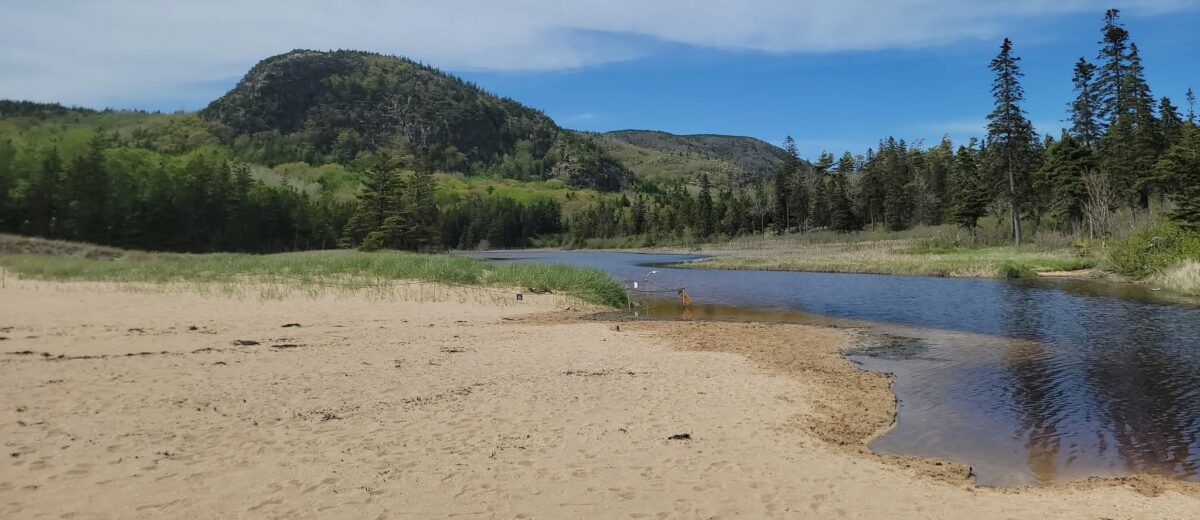
Dr. Katie Castagno, director of the Land-Sea Interaction Program at the Center for Coastal Studies in Provincetown, Massachusetts, will study the impacts of past storms on Sand Beach, a unique feature and one of the most popular destinations in the park. Working closely with Tommy Tucker, a colleague at the Center, Castagno will bring together several forms of data: sediment cores in the lagoon just beyond the beach will show the effects of severe storms of the past, while salinity loggers will track present-day inundation of the lagoon with sea water. The study will also involve contributions from visitors in the form of a repeat photography station to document the impacts of specific storms on the structure of the beach.
Deirdre McGrath, a PhD student in anthropology and environmental policy working with Dr. Bonnie Newsom at the University of Maine, will use drone-mounted sensors to assess erosion rates of Wabanaki cultural sites. These shell mounds, which number in the thousands along the coast of what is now Maine, are rapidly eroding due to storms and rising sea levels. Working with Tribal Historic Preservation Officers and a drone pilot, McGrath will survey archaeological sites in Acadia. The resulting multispectral images can be compiled with detailed GPS data to create three-dimensional digital models to measure local erosion rates and inform decisions about how to protect important sites of cultural continuity.
With these awards, 26 fellows have been supported by Schoodic Institute since David Evans Shaw founded Second Century Stewardship in 2016, the centennial of the National Park Service. Through thoughtful and relevant scientific research, fellows have expanded knowledge of Acadia’s dynamic ecosystems and human relationships, while strengthening collaborations among researchers, educators, students, and park staff.
These fellowships are among some 90 research projects that will take place in Acadia this year, facilitated by Schoodic Institute, Acadia National Park’s primary partner in science and education. A nonprofit organization, Schoodic Institute supports conservation science in and beyond Acadia. Learn more at https://schoodicinstitute.org/science/