by Tiegan Paulson
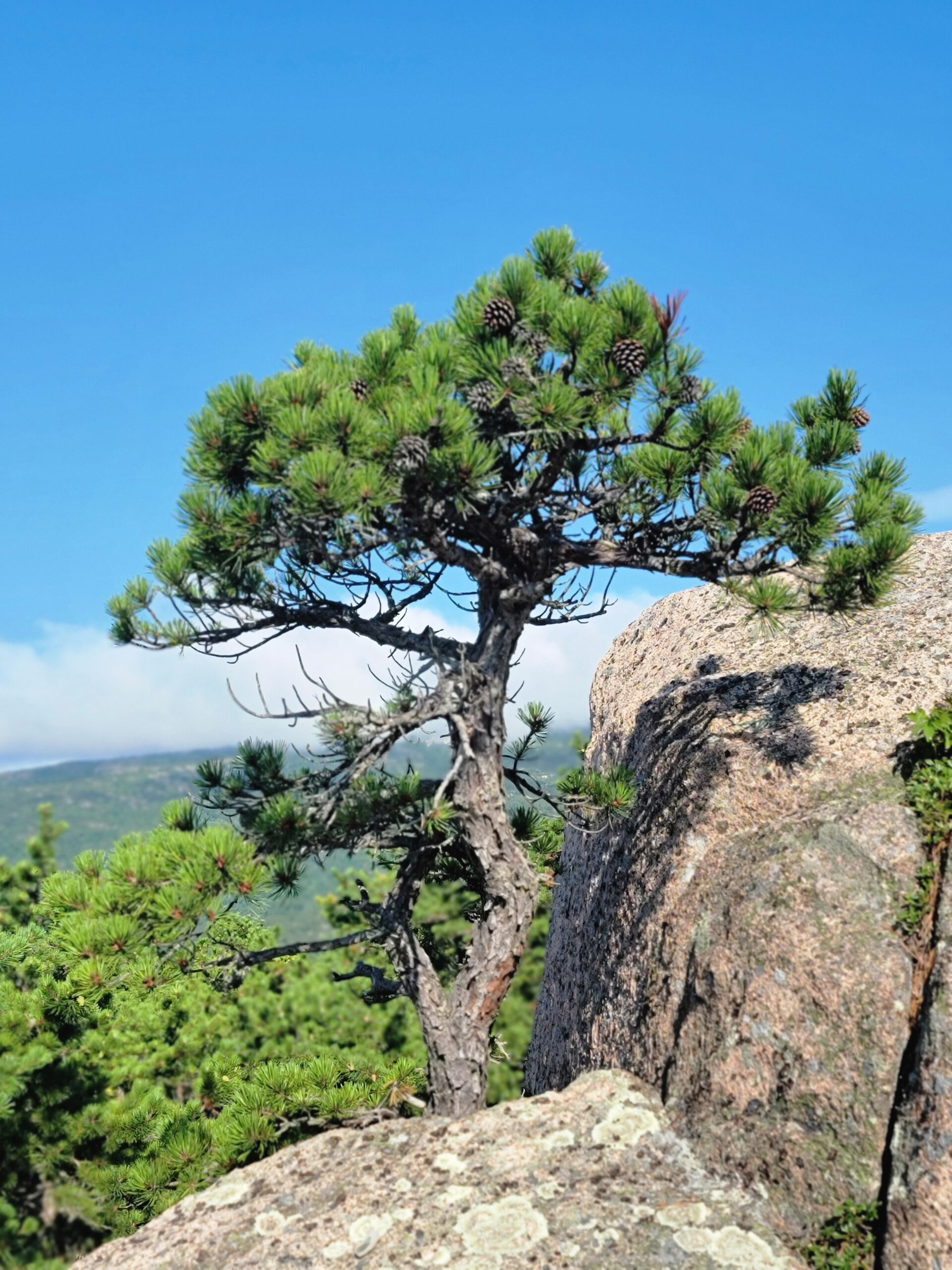
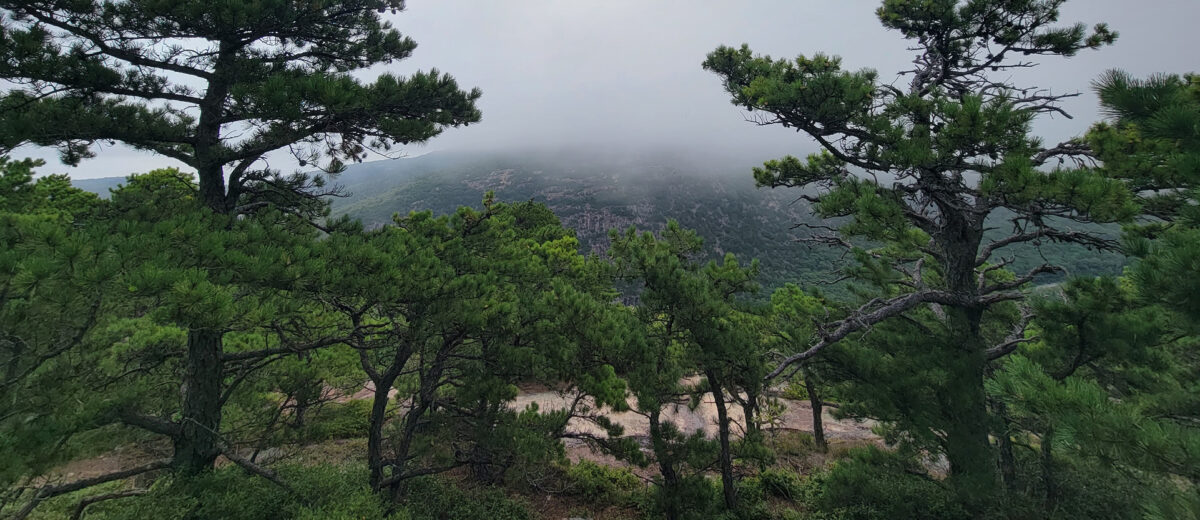
There is a big difference between the bottom of Dorr Mountain and the top. At the base of the mountain, the shady trunks of the Hemlock Trail fall away, and in less than a mile the higher elevation is covered in brown, scrubby little trees that cling to rock and patches of soil. These are pitch pines, and their cracked, weathered bark testifies to the harsh conditions in which they grow.
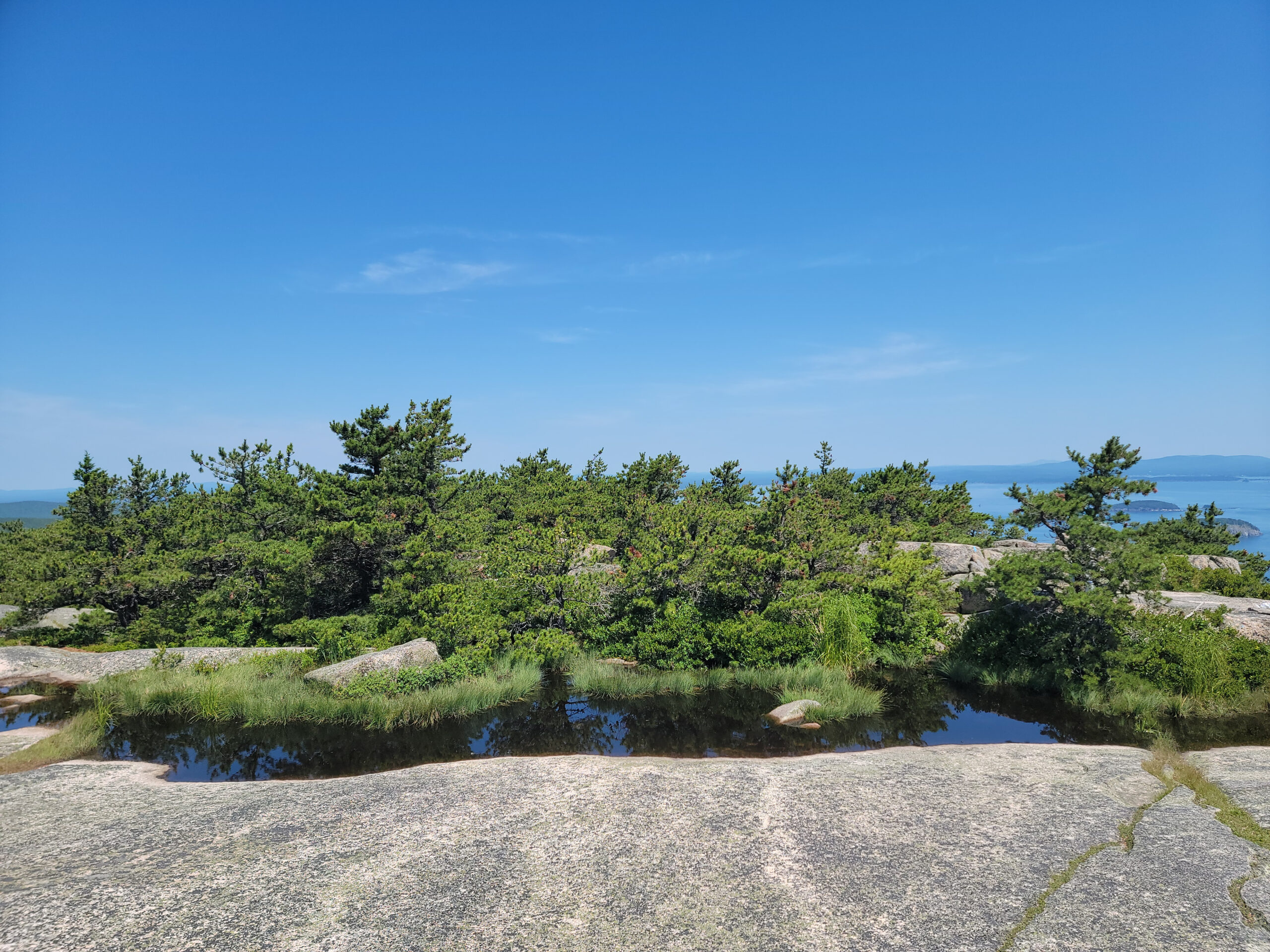
Pitch pines are common on Acadia’s peaks, growing in dry, low-nutrient soil where most other species struggle. Harsh living is so much their thing they rely on fires that open their seed cones and clear out other trees. But there hasn’t been a significant fire on Mount Desert Island since 1947, so why—after nearly eighty years—are pitch pines doing so well?
Jeff Licht, of the University of Massachusetts, and Nicholas Smith, of Texas Tech University, who study a variety of plants, theorized that a combination of other factors—such as the amount of water available and the distance to salty spray from the sea—must be filling the “harshness” role of fire. In four pitch pine forests on various slopes and distances to the ocean in Acadia, they measured tree size, distance from other trees, soil, gradient and direction of the slope, and other landscape characteristics.
Licht and Smith found that areas where soils had few nutrients and where water drained quickly had more pitch pine seedlings growing. They also found evidence of a salt spray “sweet spot.” Stands of trees close to the ocean had fewer seedlings than those with a small buffer of other trees between them and the ocean. So no fire, no problem.
But pitch pines in Acadia face another challenge: the arrival of southern pine beetle in New England. Native to the southern United States, southern pine beetles historically were limited to mostly south of Virginia by the winter cold. As the northern winters have warmed, the wood-boring insects have been able to expand north to New York, Massachusetts, and as of 2021, southern Maine.
The beetles reproduce by burrowing through the bark and laying their eggs in the phloem, the first, thin layer of wood that moves nutrients and sugar up and down the trunk. If too many beetles go after one tree, the phloem connection between the leaves and the roots is interrupted.
The trees protect themselves by flushing the beetles with thick sap, killing them. A tree can survive a few beetles, but can be overwhelmed by too many all at once. The beetles take advantage of this, releasing pheromones into the air to call other beetles to a specific tree. The results can be devastating, sometimes killing huge swaths of pine forest.
Temperatures of -7 °F typically kill about 90% of beetles in an area, but are pitch pine stands in the Northeast still reaching those temperatures? Caroline Kanaskie, an Acadia Science Fellow and doctoral student at University of New Hampshire, worked with professors Mark Ducey and Jeff Garnas to more closely examine climate conditions in areas with and without southern pine beetle.
Kanaskie recorded temperature in selected plots in Acadia, Cape Cod National Seashore, and Fire Island National Seashore. The devices recorded temperatures through the winter, which the team checked for the absolute minimum temperature at each site. None reached the -7 °F threshold. The top of Cadillac Mountain was the coldest at 1 °F, sufficient to kill approximately 45% of a theoretical beetle infestation.
Even if temperatures had been cold enough to kill southern pine beetles, they likely won’t be in the future. To better understand the threat posed in Acadia, where southern pine beetle has not been detected, the team assessed the density of the pitch pine stands at 177 sites in the park. Tightly packed trees are good for southern pine beetles in two ways: they offer an easy, condensed source of food, and they subdue winds that might have otherwise dispersed the pheromones the beetles use to communicate. Stands where pitch pines are more spread out are harder places for southern pine beetles to thrive.
According to the research team, Acadia’s pitch pines are pretty densely packed. Spots like Dorr Mountain, are at a level that previous research suggests can foster beetle outbreaks. That leaves managers with three options: resist, accept, or direct. Resisting means treating and removing trees as they become affected. Accepting is letting nature take its course, removing trees only as they become hazards. And directing is preemptively thinning stands of trees before the arrival of the beetles.
Kanaskie, now an assistant professor at University of Maine at Fort Kent, thinks direct, preventative action could be the most effective means of limiting beetle numbers, in the event they come to Acadia. She acknowledges it is the most expensive option in the short-term, but notes that everything will have some financial cost eventually. And, as Jeff Licht and Nicholas Smith noted in their paper, if other species could move in where pitch pines were, they probably would have already. Those places might not have any trees at all.
There are still questions to ask about how other parts of the environment—like soil composition and altitude—might change southern pine beetle’s impact on pitch pines in the park. For the time being, managers in the park have far more information available to help them make decisions about Acadia’s unique pitch pine ecosystems.