
by Catherine Schmitt
 On any given summer day, hundreds of visitors take in the view from the summit of Cadillac Mountain in Acadia National Park. Most of the view is island-studded ocean, but the feeling of being on a mountain, the highest summit along the U.S. East Coast, is in part due to the short and scrubby plants that grow near the ground.
One of those plants is three-toothed cinquefoil. Evergreen but bright red in fall, with leaves fanned out in clusters of three, cinquefoil’s creeping runners spread and fill cracks in Acadia’s glacier-scoured bedrock, trapping dust and sand so that other plants can take root.
Like the jack pines and balsam fir that also grow in Acadia, three-toothed cinquefoil is more characteristic of higher mountains and colder regions. These species have persisted here because of the cooling effect created by the mountain-and-ocean landscape. Today, scientists are interested in such areas, known as “refugia,” because they may be buffered from current rates of warming. For managers of parks and other conservation lands, identifying and protecting refugia might allow survival of local populations that are either unable to quickly adapt to changes in place, or else aren’t able to move, according to Schoodic Institute climate change adaptation scientist Chris Nadeau, writing in a special issue of the journal Conservation Science and Practice.
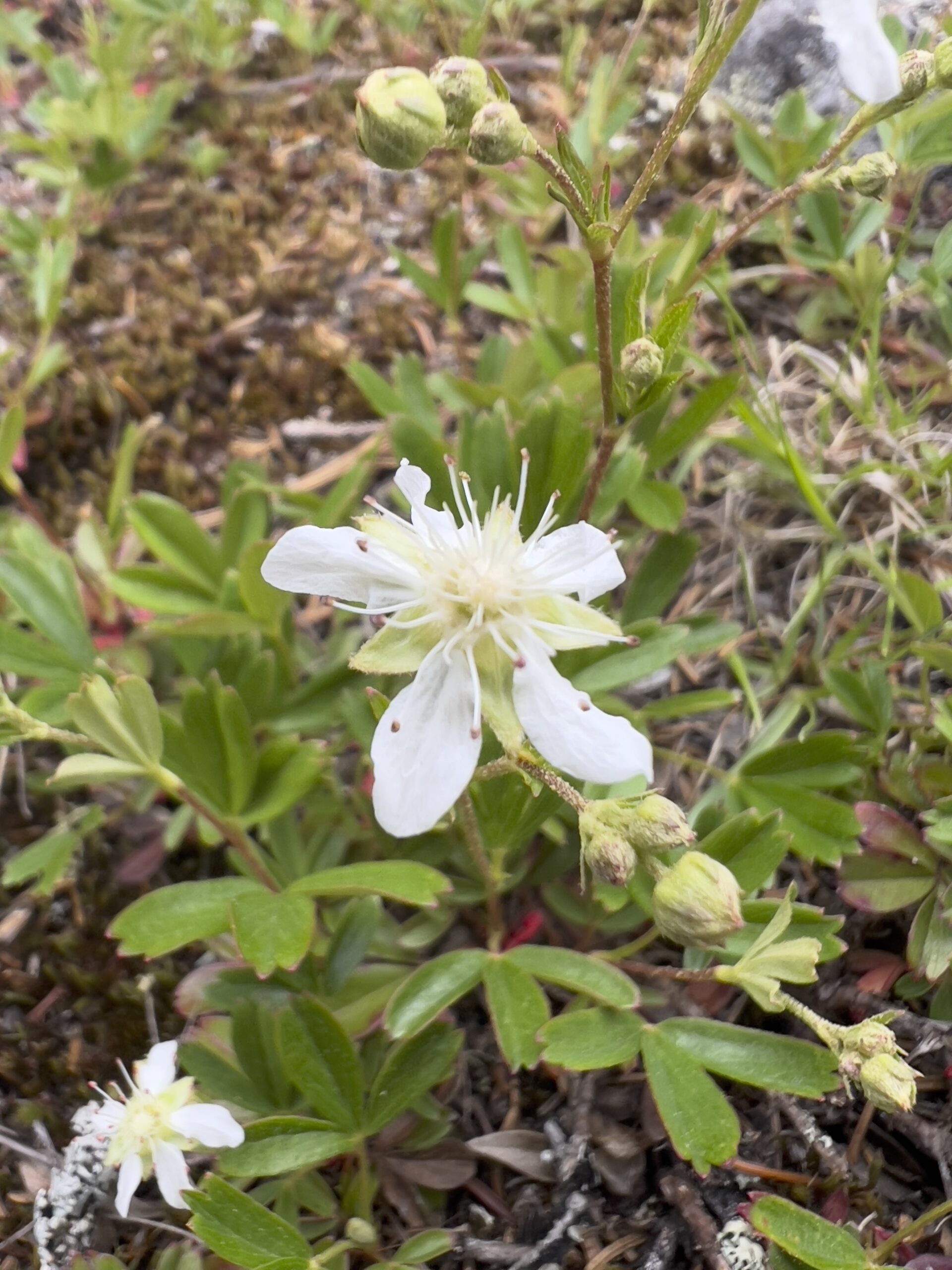 A focus on refugia in Acadia began in 2017, when Toni Lyn Morelli, adjunct full professor of environmental conservation at UMass Amherst and US Geological Survey research ecologist, and Jennifer Smetzer, a Second Century Stewardship Fellow, met with park staff and other agencies and organizations. Among the species of interest they identified was three-toothed cinquefoil, which likely reduces soil erosion on mountain summits and coastal headlands. Another small, low-growing, cold-climate plant, black crowberry, plays a similar role on coastal cliffs, bluffs, and islands. Smetzer’s models of both current and future habitat showed that Acadia may have important climate change refugia for both species. Cadillac Mountain was identified as the only mountain with future refugia for cinquefoil.

For most refugia research projects, the story would have ended there. Fewer than one-third of studies verify predictions with independent data, according to Morelli, Nadeau, and others in another article in the special issue. They highlighted Acadia as a rare example of refugia science that has gone beyond modeling to actually ground-truth predictions while incorporating research results into management. “Only one percent of studies monitor the effectiveness of refugia management,” said Nadeau. “This is where our work with volunteers fits in.”
 In Acadia, teams of Earthwatch volunteers led by Schoodic Institute have helped to monitor the presence, health, and growth of cinquefoil and crowberry inside and outside of predicted refugia. Their survey data showed that plants outside of refugia didn’t necessarily exhibit more stress. “There might be factors other than temperature influencing plant growth, at least for now,” said Kyle Lima, Schoodic Institute data analyst and case study co-author, noting that volunteers are excited by the relevance of the work and motivated by the clarity of the scientific question.
That other factors are at play was also suggested by greenhouse and “common garden” experiments, described in the case study, that Nadeau designed to further test the assumptions of climate vulnerability underlying the models. Three-toothed cinquefoil growth and survival were reduced under increased temperatures as models predicted. However, other variables, such as soil moisture and salinity, might also be important to modeling and managing refugia for both species. “In one of our greenhouse experiments,” said Nadeau, “plants that were watered regularly grew well even at really high temperatures, suggesting that finding a way to increase soil moisture in natural settings could be a way to mitigate the negative impacts of high temperatures.”
 Acadia is also unique for trying to manage park resources with refugia in mind. On Cadillac Mountain, the National Park Service has been trying for years to restore vegetation lost to visitor trampling, soil erosion, and intense rain storms, in partnership with Schoodic Institute, Friends of Acadia, and Native Plant Trust. Three-toothed cinquefoil has been one of the most successful plants in those experiments, and so when the team established new restoration sites on Cadillac Mountain in 2023 and 2024, they located them in the areas Smetzer had identified as refugia, planting cinquefoil seeds in the freshly added soil. And park staff are now considering refugia as they enter the planning stages of repairing storm-damaged coastal cliffs and islands. This, too, stands out as unique. Another case study from the eastern U.S., also part of the special issue article, found that priority areas for habitat restoration rarely overlap with identified refugia.
Toni Lyn Morelli calls refugia a potential bright spot in the otherwise grim science of climate change. Morelli helped refine the concept of refugia in the context of ongoing climate change.
“There seem to be these special places, all over the world, where the rate of climate change is slower than in the surrounding areas,” said Morelli. “What if we could identify these spots and figure out which species they could protect from warming, fire, and other threats? What if we could connect these spots, so that as the climate changes, plants and animals would have corridors through which they could track their preferred climate and avoid the worst of global warming?”
Nadeau continues to test other restoration strategies, evaluating whether increasing genetic diversity or planting cinquefoil from warmer areas might improve the resilience of cinquefoil on mountain summits not identified as refugia. He’s also thinking smaller. “There might be restoration opportunities in suitable microclimates, which were not included in the refugia models due to the resolution of the climate data.”
Areas under the trees might be one such microclimate. Another study, recently published in the journal Ecosphere, identified “snow refugia” areas beneath moderate forest canopy cover on Acadia’s mountain slopes. More details may come from the ongoing research by Acadia Science Fellow Colby Bosley-Smith to monitor climate in the forest understory.
Nadeau is also thinking about the results of his greenhouse experiment, and last summer’s drought. “In 2025, in our monitoring sites, three-toothed cinquefoil experienced dramatic declines due to the drought in a non-refugia site, but remained stable through the drought in refugia sites. In the future, a hot dry summer will likely be much more detrimental than a hot wet summer.”
The hope is that by working together to identify, monitor, restore, and protect refugia, Acadia can continue to be a place of spruce-fir forests, crowberry coastlines, and alpine summits held in place by threads of three-toothed cinquefoil.

More information:
- From models to management: Implementing the climate-change refugia conservation cycle in national parks of the northeastern United States: https://doi.org/10.1111/csp2.70159
- Conserving climate-change refugia: Insights from research and practice: https://doi.org/10.1111/csp2.70160
- Press release from UMass Amherst
- Article in the Conversation
- Video from NE CASC