Introduction
America Adapts, the Climate Change Podcast and its host, Doug Parsons, visited Schoodic Institute to learn more about our conservation science. Over the next several months, we’ll be sharing with you edited interviews (click to listen) from the podcast; find the full podcast episode here.
We are continuing this month with Schoodic Institute Climate Change Adaptation Scientist Dr. Chris Nadeau.
Interview with Chris
Doug Parsons (DP): Can you describe your role as climate adaptation scientist? What does that mean day to day?
Chris Nadeau (CN): On a basic level, I try to ensure that the money we’re spending on natural resource management today continues to provide benefits in the future as climates change. In practice, I work with natural resource managers, often at Acadia National Park, to try to identify the uncertainties that limit their decisions or stop them from being able to do management that they think will last into the future. And then I work with them to design experiments to try to resolve those uncertainties so that they can make more informed and hopefully better management decisions moving forward. It involves a lot of different work, ranging from the mountain summits in Acadia National Park down into the wetlands right next to the ocean.
DP: How long have you been doing this work here?
CN: I’ve been at Schoodic Institute for two and a half years, but I started working with them during my Ph.D., when I was awarded a Second Century Stewardship Fellowship (now called the Acadia Science Fellowship) which helped me build relationships here at Schoodic Institute. I continued the collaboration with another postdoctoral fellowship, and I was lucky enough to turn that into my dream job as climate adaptation scientist.
DP: When I came to visit you, we visited some field sites. Can you describe some of the places we went to and what we were looking at?
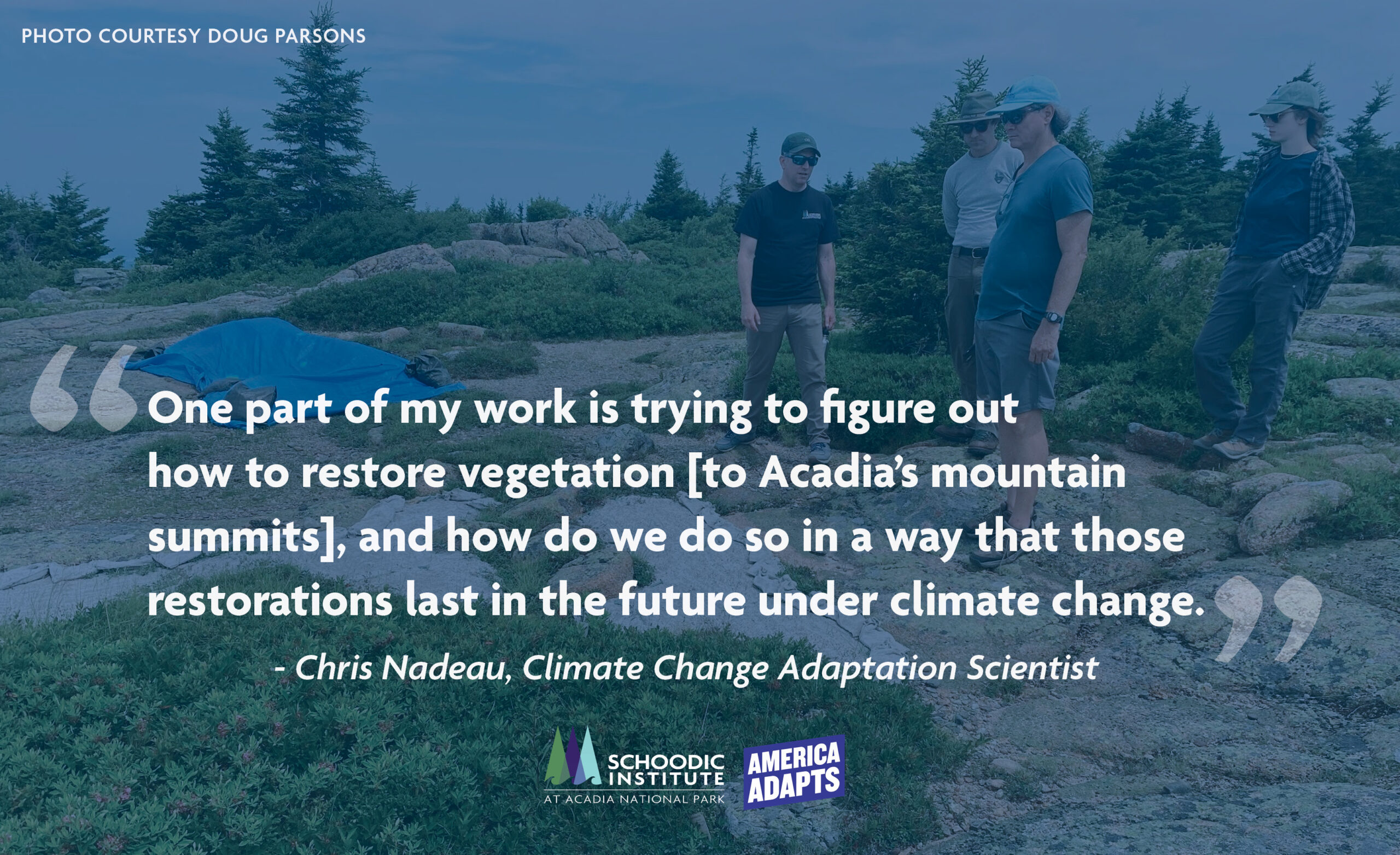
CN: I’ve got three ‘buckets’ of research and in three really beautiful locations in Acadia National Park. The first one of those buckets is mountain summit restoration. If you’re out West and you’re thinking about these big, tall 14,000-foot summits, that’s not what we have here. We have these 1,500-foot summits, but they’re extraordinarily beautiful. They look out over the ocean, and they’ve got these amazing plant communities that are unfortunately being trampled by the many people who visit them. One part of my work is trying to figure out how to restore mountain summit vegetation, and do it in a way that lasts in the future under climate change. The second bucket I work on is invasive shrubs. One of the biggest threats to the forests and wetlands here is invasive shrubs, and so we’re trying to figure out how to better manage those shrubs, whether they can be prevented by planting more locally adapted species, which ones to plant. The third bucket involves working with birds. One of the studies we’re working on now is in spruce-fir forests, which are just a beautiful forest type that occurs here on the coast of Maine. They’re pretty threatened under climate change, we think. And we have this great opportunity to resurvey a forest that was surveyed back in the late 1950s. We’re re-surveying the birds in that forest to see how bird communities have changed.
DP: Let’s talk about RAD. What is RAD? This is something that’s a key part of how you do science there, right?
CN: It’s an acronym, stands for Resist, Accept, Direct. It’s really a framework for making decisions. In a changing climate, we’ve got three options for how we manage natural resources. The first one is that we just try to resist change and we try to keep things the way they are, keep the current tree species for example. The second option is to accept whatever happens. If the tree species that are here now change in the future, we’ll just let the forest change into whatever it’s going to change into. And then the third option is direct. And that’s a case where we might not want the changes that we would get under the accept option. And so instead, we’ll try to maybe plant tree species that we want to be here in the future, directing change towards a desirable future condition. A lot of the work we do is about testing different strategies to resist, accept, or direct change.
DP: Let’s talk about your process. Who’s at the table and how do you co-produce science with the National Park Service?
CN: How it works is a lot of meetings, to be honest. But that’s a good thing. I think co-production is this process where managers and scientists work together to try to develop science that really has application on the ground for management. And it’s talked about a lot, ecological circles, but it’s not done often, because it really requires strong relationships between scientists and managers. Schoodic Institute is a nonprofit science organization that’s embedded right in the national park. And that means that I have really close relationships with park managers. For example, just yesterday, I was sitting at a picnic table with the vegetation program manager at Acadia, and we’re able to just chat casually about how are we going to adapt to climate change? What information do we need to know so that we can make good restoration decisions on our mountain summits? And it’s really those casual conversations that start the process. And then, because we have close relationships, we spend a lot of time developing experiments to answer those questions or developing vulnerability assessments, in this case for climate adaptation, together. I think that’s the really important part is that we develop and implement the science together. That way, the science is really relevant to the natural resource management and the managers are more likely to implement the results from that science when they do management.
DP: Obviously, climate change is unpredictable. How do you build in that flexibility to adjust in real time when the science or the field conditions are surprising you?
CN: That’s a really good question. I think that also comes back to our relationships. We’re not doing the type of science where we ask the manager what they want, we go away for five years, and then we come back and tell them what the results are. We’re discussing the results of our science all the time with managers. For example, just this morning, I was in a meeting talking about the big drought that we’re going through right now and how the vegetation looks so crispy and that brought up the idea that we should be going back to some of our plots that we monitor long-term to see how is this drought affecting the plants? Then we’ll incorporate that information into our restoration. We can talk real time about what the data are saying and how we can adjust management actions.
DP: I talk about this increasingly on the podcast, and that’s climate modeling. And for the public, that can be very abstract. And even for organizations like yours, trying to figure out how to use them properly. How do you do that?
CN: We’re not in the climate modeling business. We’re not trying to predict the climate itself. We’re trying to predict how climate change will affect natural resources, particularly species we’re interested in managing. We use climate data provided by international, national, and state scientists. But there’s uncertainties in these models. There’s a whole class of models that we work with called species distribution models that try to predict whether a species is going to remain here in Acadia National Park or be extirpated from the park in the future. And when you take climate data that has uncertainties and then you put it into a species distribution model, which also has uncertainties, you get even more uncertainty. We are testing those different models to try to understand, are they making accurate predictions? We do that on the ground, through things like installing open top greenhouses that simulate climate change, or implementing an experiment at the top of a mountain summit, where plants are experiencing the climate that is existing right now, and then we’ll have an experiment at the bottom of the mountain, which is about two degrees Celsius warmer.
DP: We had this conversation when we were together in person. Are you prepared for the idea that some efforts and some species are lost causes? And how do you decide to keep trying or to pivot or give up?
CN: As a scientist, I’m not making that decision. That’s the National Park Service’s decision. And that decision is made using the best available science, but also there’s a lot of values that go into those types of decisions… I’ve mentioned mountain summits here a lot. There’s a few species on the summits that are really at the southern end of their distribution, and they probably just occur here because we have these cold areas next to the coast, these higher elevation areas, and they might not occur here in the future. Do we put a lot of effort into restoring those species or not? That’s a question for the National Park Service. But science can inform those questions… I think that’s what Resist Accept Direct is all about, trying to make that first decision. Do we want to keep the species we have here and invest a lot of money in doing that? Or do we need to try something else?
DP: So why is it so important to experiment when there isn’t much evidence yet that these strategies will work?
CN: That’s the exact reason we need to experiment. There’s dozens of climate change adaptation strategies out there that have been proposed by scientists and that land management agencies and other agencies are implementing all around the world. But we have almost no evidence that those strategies will actually accomplish the objectives we think that they’ll accomplish. And some of these strategies are key, right? Like, for example, a common strategy is to move species from the south to the north. And when we move species around like that, we have the risk of moving diseases or pathogens or potentially creating a new invasive species. And so we can’t just be doing these things willy-nilly without knowing if they’re going to provide the benefits and whether those benefits outweigh the risks. And so that’s really a big part of my job is to design rigorous scientific experiments to try to understand will these things work or not? I’m hopeful that there’s a community of people like me doing these experiments all around the world and that in five or 10 years we’ll have a good collection of studies that we can really provide evidence to managers to say, this strategy will likely work in this context. Go ahead and do it and give them that confidence that they’re investing money in something that’ll work.
DP: Stepping back a bit, I know we had this conversation before at the park, but what do you see as a bigger threat to Acadia National Park’s future, climate change or the sheer number of visitors the park receives every year? It occurred to me as I was coming up with this question, climate change isn’t going anywhere and neither are lots of park visitors. That’s going to just be something that you’re dealing with indefinitely. So what do you think is a bigger threat?
CN: It’s a really good question and a tough one to answer because I think they’re not independent of one another, right? They interact. And for example, this year has been a really sunny, warm year. That’s what we expect to see in the future as climates continue to change. And sunny, warm days bring lots of extra visitors to the park. And when there’s lots of extra visitors to the park, there’s more opportunity for people to have impacts on the landscape. And we see those impacts. Acadia’s mountain summits are some of the most beautiful places in the park. When you get thousands of visitors up there, then they just happen to step on the vegetation and that can kill the vegetation. And so in that way, people are a big threat to the park and increasing visitation under climate change will just exacerbate that threat. But on top of that, we expect longer periods without rain, and we’re in one of those periods right now. And that dryness makes vegetation really vulnerable to trampling. And so in that way, too, we get these dry periods that also have a lot of visitors and that can have extra impacts. And then on top of that, the way we get rain now is that we get these long dry periods and then we get a really heavy downpour. And so if visitors have trampled vegetation and killed that vegetation and we get a really heavy downpour, then that just washes the soil right off the mountain. And then it’s really hard to get those plants back. In fact, that’s a big objective of our restoration project is to restore soils in places like that. Are people or climate change a bigger threat? We can’t separate those two things, I don’t think.
DP: How do you think the work you do at Schoodic Institute fits into adaptation efforts beyond Acadia?
CN: I think it goes back to testing these strategies. Land managers all around the world are faced with a lot of the same issues under climate change. And they have suggestions on what they should do going forward, but there’s just so much uncertainty about whether those suggestions will work. I always come back to this title of this paper that Laura Hansen from EcoAdapt published with her colleagues. And the title of the paper was A Good Idea, or Just an Idea? Climate change adaptation strategies have been proposed, they sound like good ideas, but are they good ideas? We don’t know. And so the work that we’re doing here at Acadia, I think is easily translated beyond Acadia to people in the Northeast also struggling with these same issues, but also to the bigger picture worldwide. And like I said, I think the hope is to put together a big database of tests of adaptation strategies so that in the future we can say in different ecosystems and different parts of the world under different contexts, when do these things work and when do they not work?
DP: Are there any other partners who are really helpful in your work?
CN: I’ve mentioned the National Park Service a lot, and obviously we work super closely with them, but we also work really closely with Friends of Acadia, and they’re just an amazing partner. I think it takes all of us to really learn how to adapt to climate change.
DP: What is your favorite spot in the park? One spot. Because everyone gives me these multiple answers or the whole park. And I’m not going to let you get away with that.
CN: It is really hard to pick a favorite spot. But I think my favorite spot is probably the top of Sargent Mountain. It’s a 360-degree view, ocean on all sides, beautiful vegetation. It’s just such a cool place to be, and I feel super lucky to be able to do a huge part of my work there.