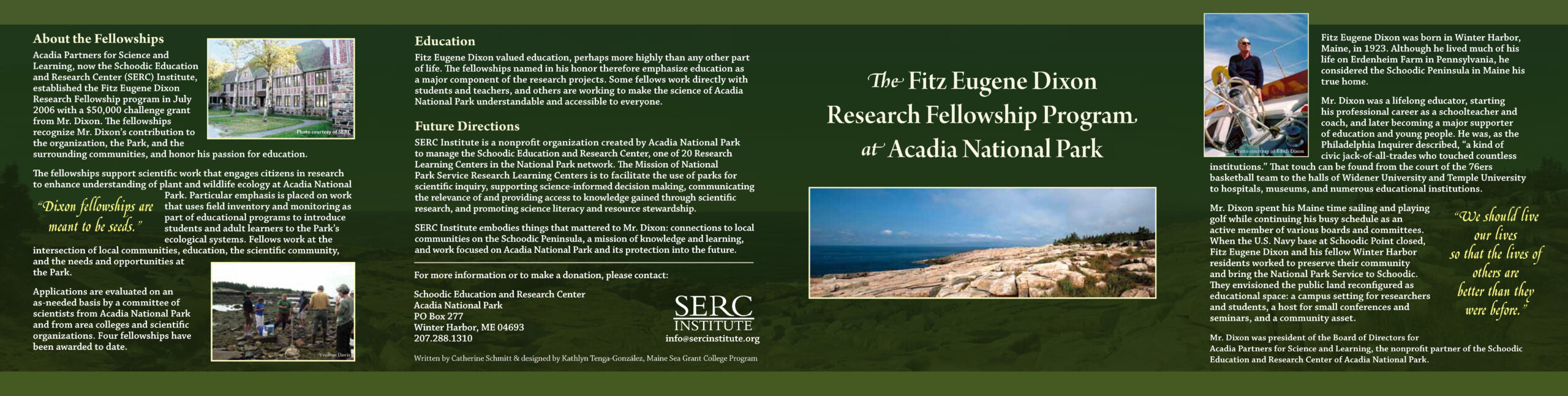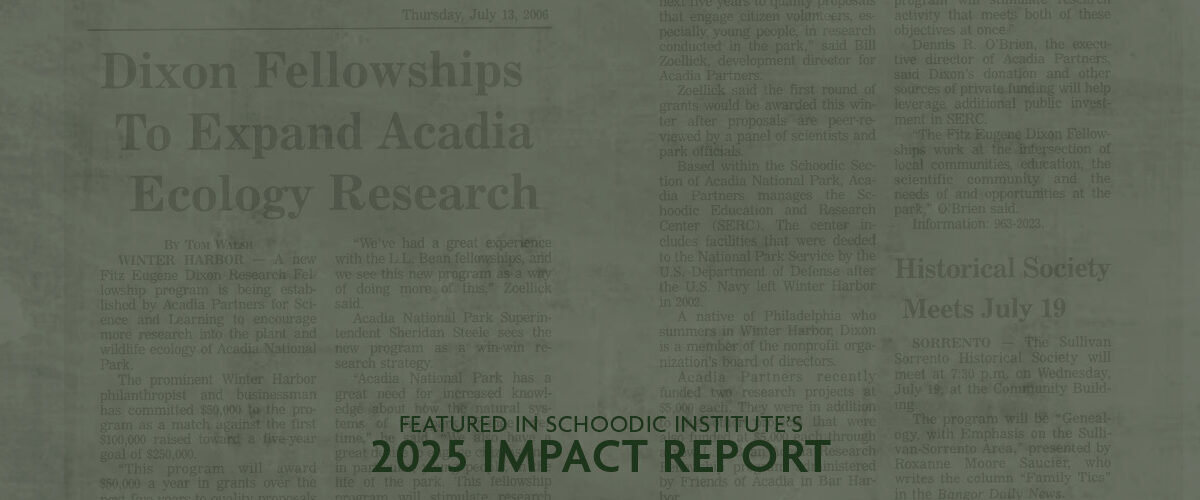
Through several fellowship programs, we have helped expand research in Acadia. One of the earliest was the Fitz Eugene Dixon Research Fellowship, established in 2006 with generous support from the Dixon family and through the leadership of Bill Zoellick. An initiative that was part of a larger effort to increase scientific research within the park, the Fitz Eugene Dixon Research Fellowship was established to support and expand ecological research in Acadia.
Learn about the inaugural class of Dixon fellows–and where they are now–below, as featured in our 2025 Impact Report (coming soon in print and online).
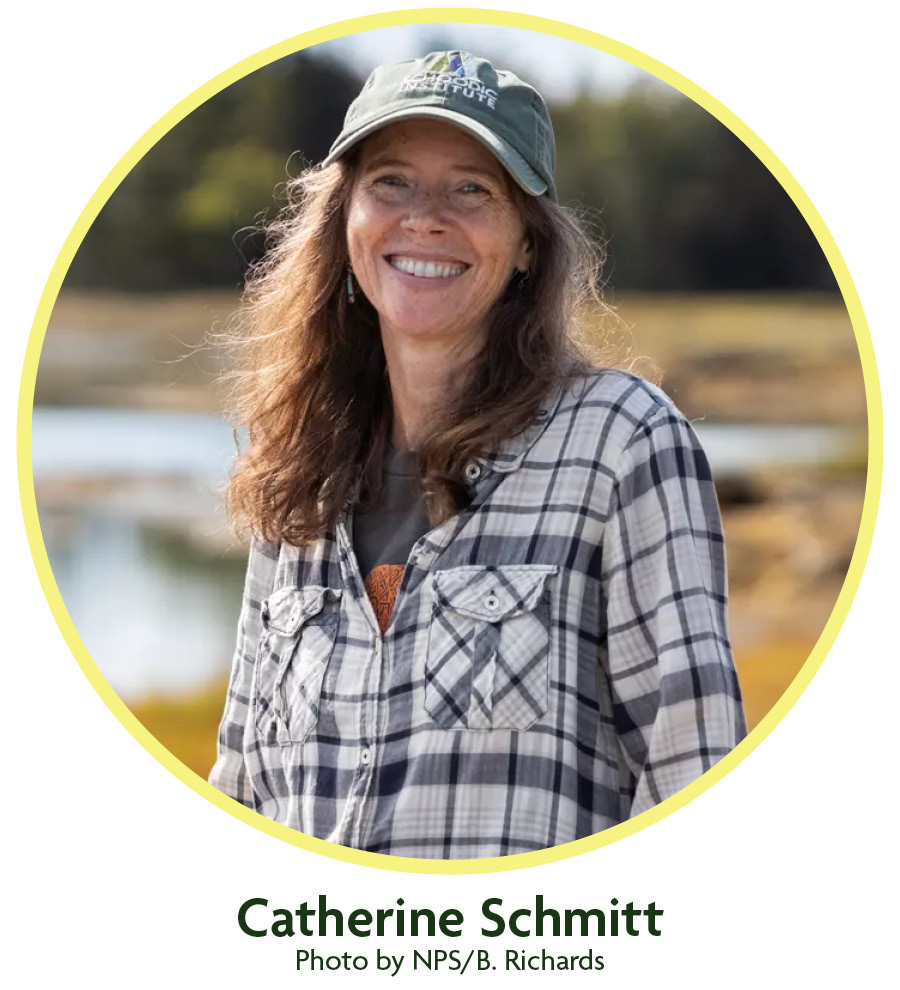 Catherine Schmitt, current Science Communication Specialist at Schoodic Institute
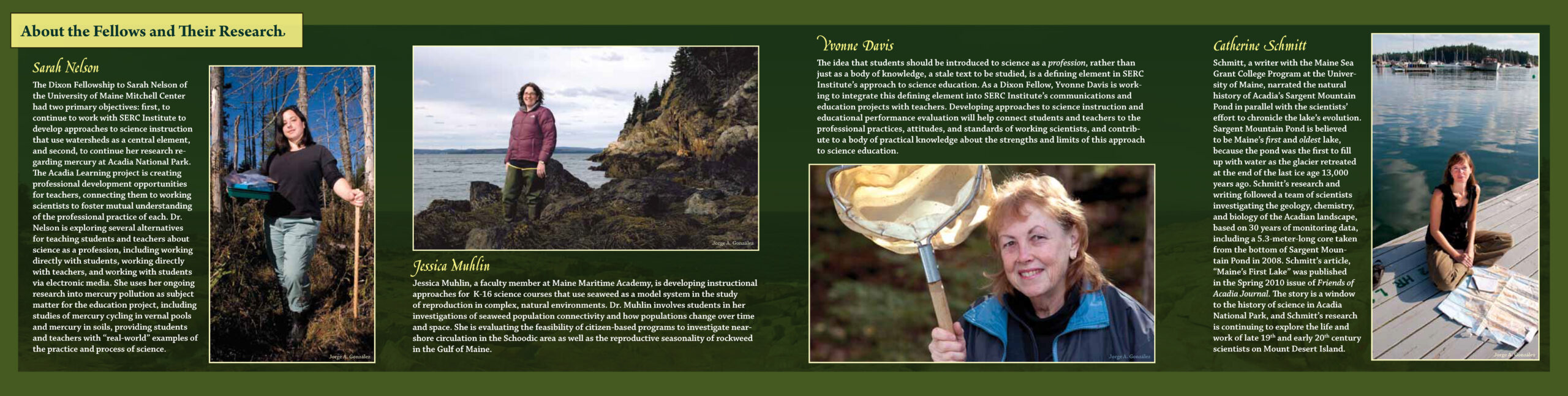
Catherine Schmitt’s path to Schoodic Institute did not begin with a fellowship application, but rather through redirection of an application from a different grant all together. As a science writer with Maine Sea Grant at the University of Maine, she was already immersed in the work of translating research into stories that mattered. When she proposed a project on the history and ecology of Sargent Mountain Pond through an L.L. Bean research grant, the idea landed slightly outside the grant’s scope. Still, reviewers recognized its promise and redirected their support, offering Catherine a Dixon Fellowship instead.
That redirection changed everything. Encouraged by Bill Zoellick to pursue the pond’s story while remaining open to new threads of inquiry, Catherine found herself with something rare: permission to follow curiosity. That freedom led her into the archives of the Mount Desert Island Historical Society, where she opened boxes containing the handwritten notebooks of the Champlain Society. That moment would turn out to be the beginning of more than a decade of work digitizing and transcribing thousands of pages of nineteenth-century observations.
From those notebooks emerged a far-reaching body of work on the history of science in Acadia. Catherine shared these stories through museum exhibits, lectures, journal and magazine articles, an edited volume of Chebacco, two books, and projects that continue to evolve. She can still recall the feeling of standing in the MDI Historical Society schoolhouse, opening those archival boxes for the first time and realizing that science lives as much in preserved stories as it does in the field or lab.
That realization ultimately brought Catherine back to Schoodic in a new role. In 2018, she joined Schoodic Institute full-time, where she has since helped create hundreds of stories about science in Acadia and continued her partnership with the Mount Desert Island Historical Society.
Looking at Schoodic today, Catherine is struck by how much has grown from those early years. A small but dedicated team now conducts leading-edge research and shares science with hundreds of thousands of people. A true reflection of the impact the Dixon Fellowship was meant to spark.
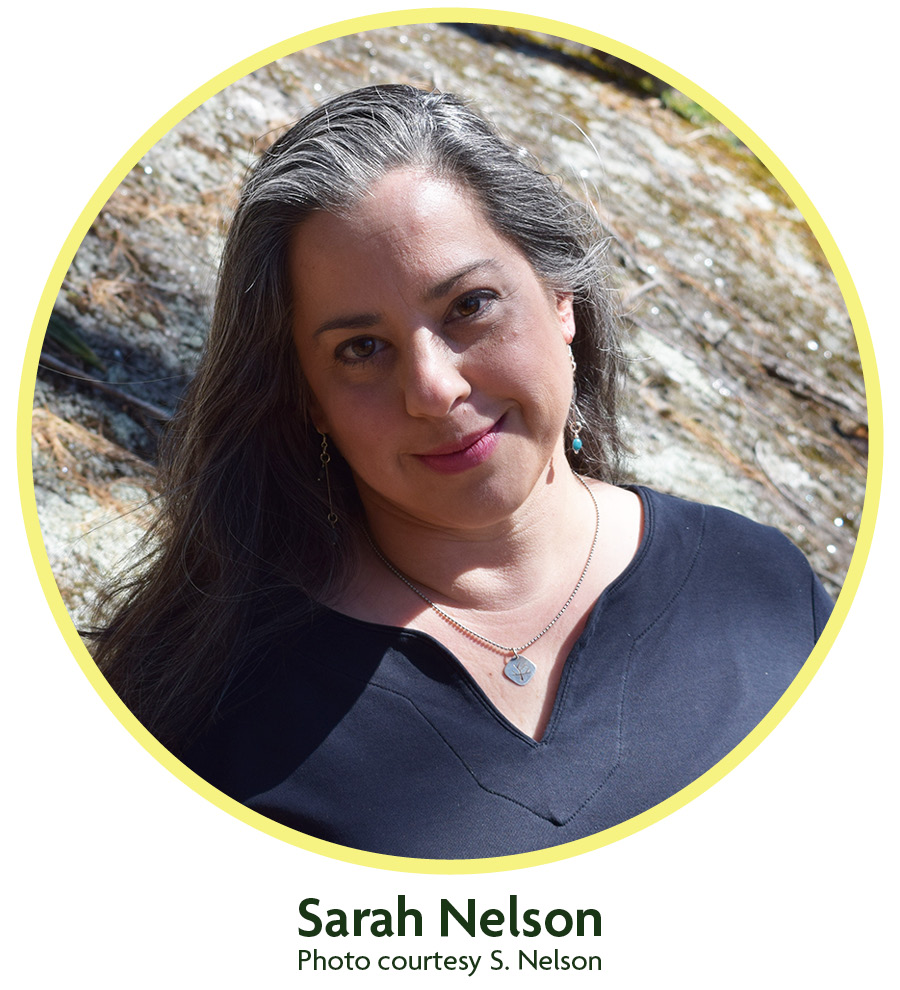 Sarah Nelson, current Director of Research at Appalachian Mountain Club
When Sarah Nelson arrived at Schoodic Institute in 2007 as a Dixon Fellow, both the campus and her career were at a moment of transformation. Schoodic Institute was still operating as Acadia Partners in Science and Learning, and Sarah was completing her PhD when she learned about the fellowship through Bill Zoellick. Sarah and Bill had just co-led what may have been the Institute’s first field course, a winter intersession for students from the Maine School of Science and Mathematics exploring geochemistry across the Schoodic landscape.
The Dixon Fellowship allowed Sarah to expand her scientific lens. While her doctoral research focused on mercury in rain, snow, and streams, her fellowship project took her into Acadia’s vernal pools: small but rich wetlands where mercury can accumulate in food webs. Working closely with Dr. Cynthia Loftin and vernal pool expert Dr. Aram Calhoun, Sarah exchanged hiking boots for waders and began tracing mercury through seasonal cycles and into developing wood frogs. This first foray into biological research proved pivotal, shaping a line of inquiry she continues today, including the nationally recognized Dragonfly Mercury Project developed in collaboration with Schoodic Institute scientists., collaboration that Sarah, now director of research with Appalachian Mountain Club, continues today.
On her first day in the vernal pools, Sarah was struck by the sudden chorus of wood frogs; an entire world revealed in places she had previously passed by. Sharing that moment, and many long field days, with two accomplished scientists at the start of her post-PhD career remains a deeply meaningful experience.
Reflecting on Schoodic Institute’s evolution, Sarah remembers visiting when the campus was still a Navy base, touring what is now Wright Hall when it served as a medical facility, and later teaching students in the modern labs that now fill the space. While much has changed, Schoodic remains what it has always been: a quiet, spectacular place to tune out the noise and be fully present in the science of the outdoors.
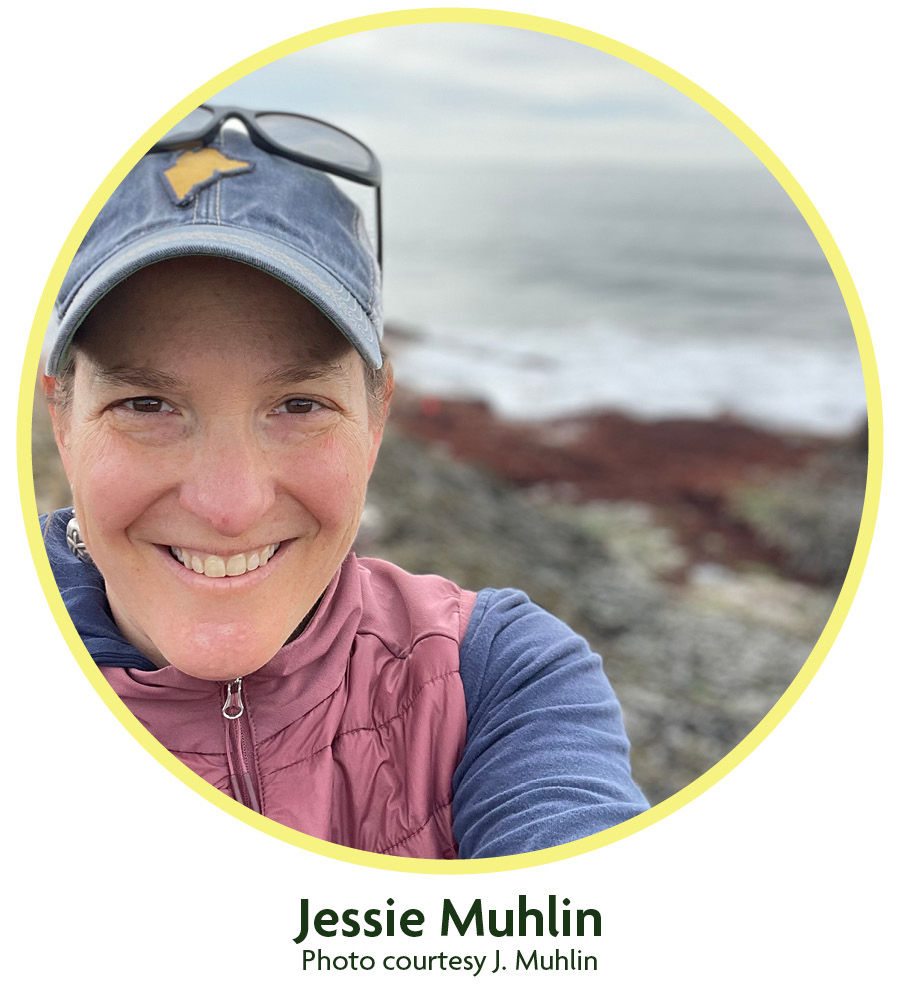 Jessie Mulhin, current Chair of the Ocean Studies Department at Maine Maritime Academy
In 2001, Jessie Muhlin, then a PhD student at the University of Maine studying rockweed, was drawn to the Schoodic Peninsula for the exposed coastline, expansive tide pools, and ecological complexity that offered a research facility unlike any other. The U.S. Navy had only recently transferred the property. Fences still marked former boundaries, and researchers relied on each other and a collective sense of responsibility. Schoodic quickly became central to her work and her growth.
Over the next five and a half years, Jessie conducted intensive intertidal research through long days and cold months, pumping seawater hourly around high tide to capture brief windows of seaweed reproduction. At the same time, she was witnessing the early formation of a research campus finding its identity. As the organization evolved, Jessie remained part of that unfolding story. She built lasting relationships with early leaders and staff and eventually became one of the first Fitz Dixon Fellows. The fellowship provided more than practical support; it validated her growing commitment to education, citizen science, and public engagement, ideas that were still emerging at the time.
Today, Jessie is Chair of the Ocean Studies Department at Maine Maritime Academy and continues to stay engaged at Schoodic and assists the National Park Service with long-term monitoring of intertidal ecosystems in several sites across Acadia each year. Her long connection reflects Schoodic’s ability to foster relationships that endure well beyond individual field seasons.
One favorite memory captures that spirit. During a late-fall research season, a snowstorm swept in, isolating Schoodic and abruptly halting fieldwork. With the campus empty, Jessie and her colleagues spent the afternoon wandering snow-covered grounds and playing on an old playground, rediscovering joy and stillness. It was a moment when science paused for wonder.
For Jessie, Schoodic Institute is a place where rocky shores, salt marshes, forests, and people meet; where science, education, and stewardship are intertwined; and where collaboration often begins simply by showing up and starting a conversation. More than twenty-five years later, it remains a place she returns to.
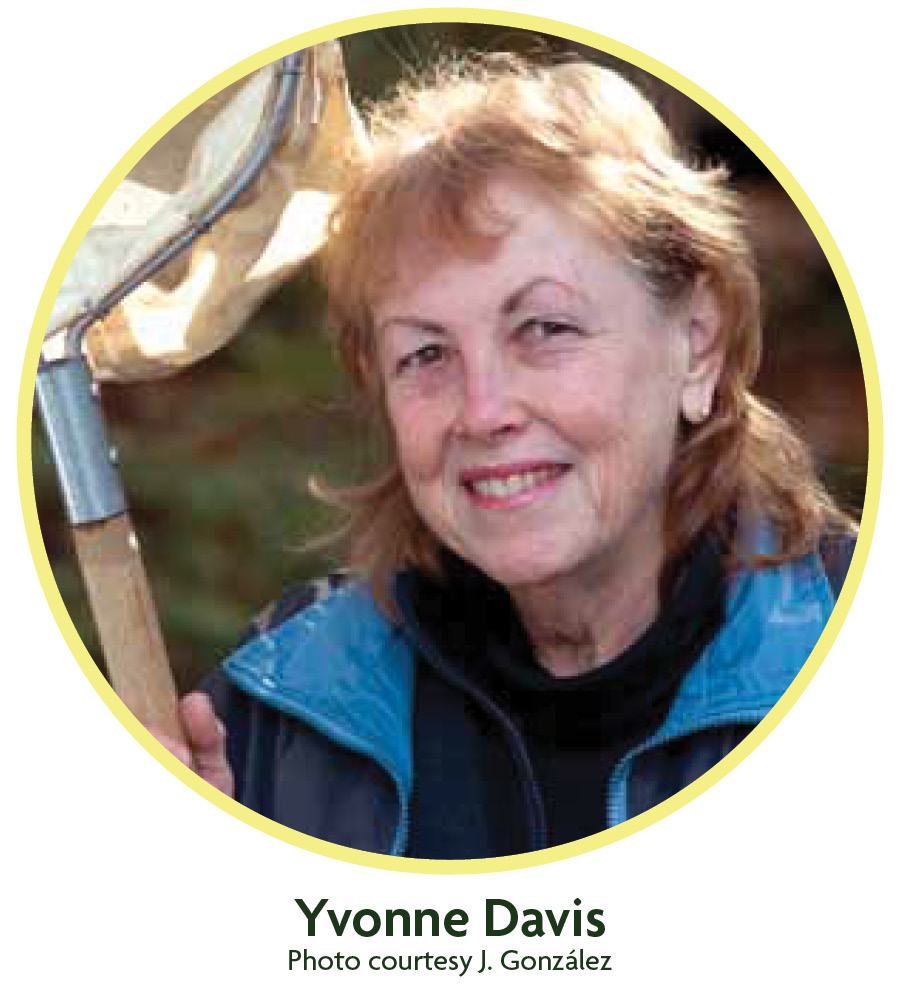 Yvonne Davis, former Director of Career and Technical Education in Maine
“I have always been a proponent of hands-on learning both as a high school science teacher, and as the state director of career and technical education,” says Yvonne. “The Dixon Fellowship at Schoodic Institute gave me the opportunity to work with students on original research. They were studying dragonfly larvae and they had to develop a research project using the scientific method. They were pleased that their work was contributing to a real research project and, while not easy, was meaningful. The work that is being conducted at Schoodic is important in understanding the area’s environment and the fact that students and teachers continue to be involved in some of the research is essential to making them better stewards of the land (and water).”