by Hannah Webber
Humans are terrestrial. We dwell on land, and think about the world from a terrestrial perspective, and it can be challenging to relate to more watery realms.
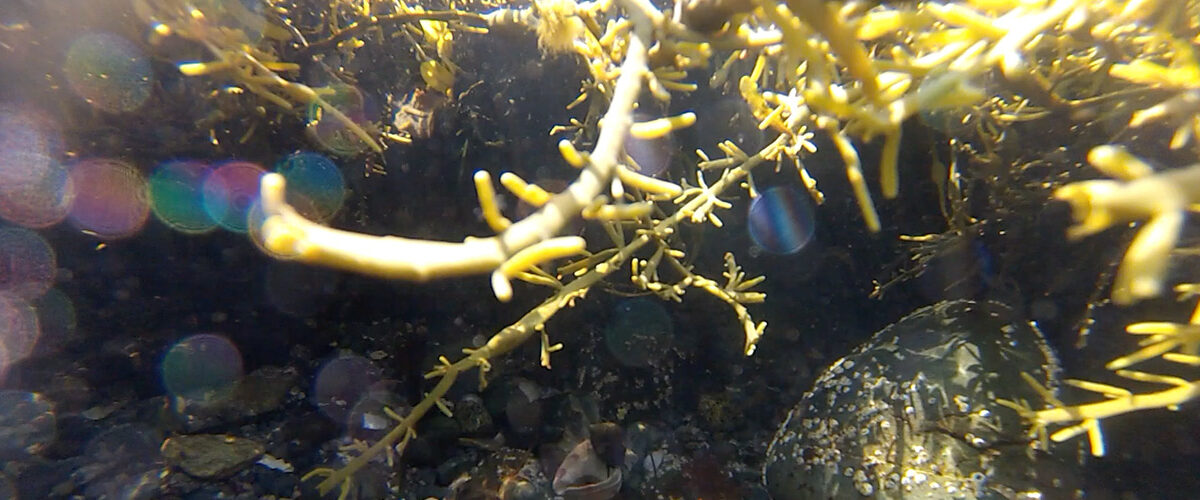
So imagine walking through a spruce forest and looking up at the canopy, the branches between you and the sky, and then looking down at the mosses and lichens on the ground. Now imagine you are on the rocky shoreline of Maine at high tide. Looking up, you’ll see a dense canopy of the intertidal seaweed, rockweed (Ascophyllum nodosum), fronds floating between you and the sky. Look down, and you’ll see a diverse community of algae and other “sessile” organisms that stay in place.
Like spruce trees, rockweed is commercially harvested, and used in a range of agricultural products. Unlike spruce harvest that takes the whole tree, rockweed harvesters remove only the tops of the algae.
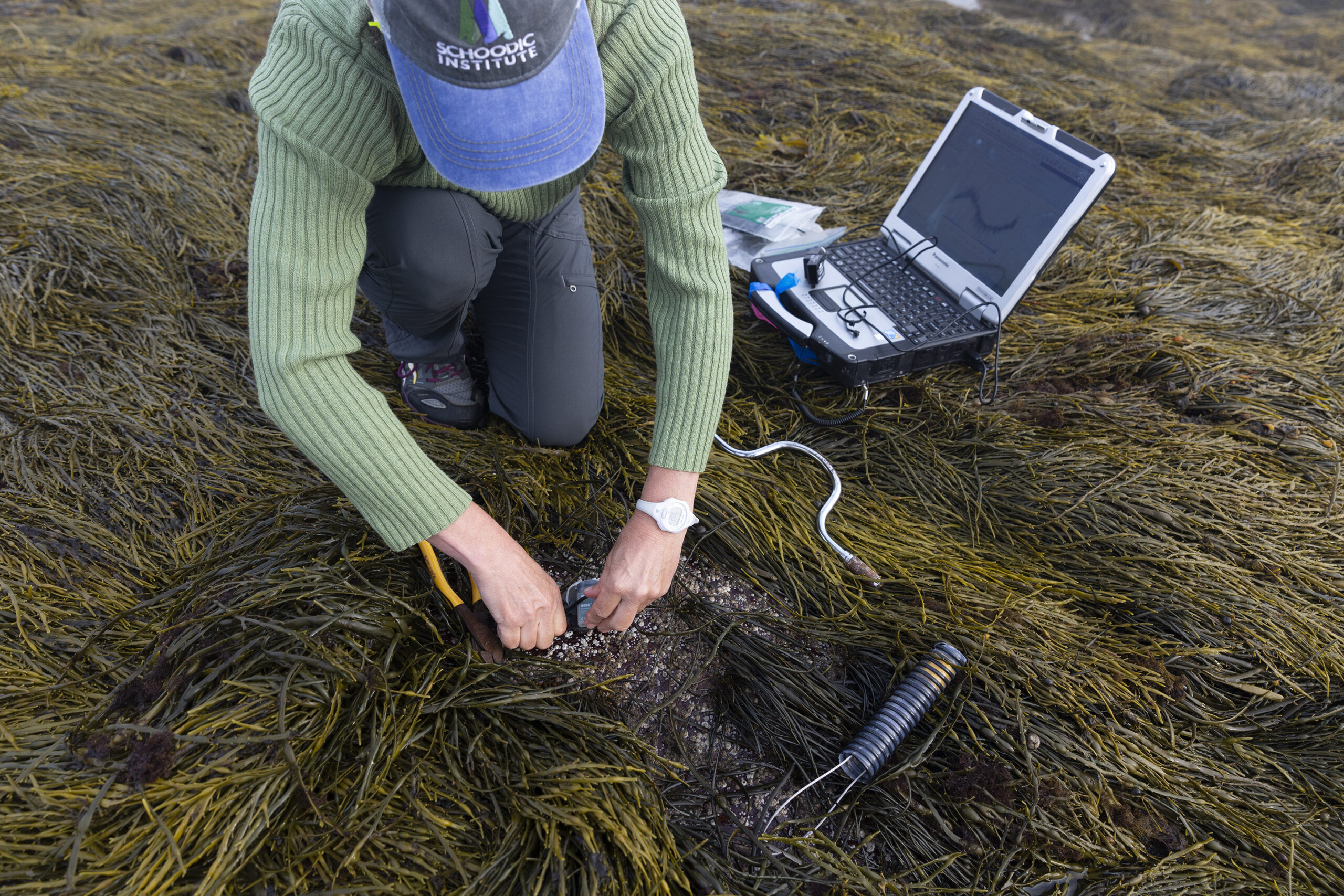 I am part of a team of researchers trying to understand how harvesting influences coastal ecosystems, an important question for both resource managers and coastal communities.
In one study, we surveyed rocky intertidal sites in Maine that were either harvested or left unharvested, and measured rockweed canopy characteristics. We also documented the number and kinds of organisms living underneath the canopy, before and after harvest. Across all of the sites, from Cobscook Bay to Casco Bay, we found that the overall composition of the sessile benthic community—those organisms attached to the rocks below the rockweed canopy—was similar in harvested and reference areas.
These results suggest that the understory community associated with rockweed beds is relatively resilient to the levels of harvest that occurred at the sites we studied. State of Maine regulations limit harvesting to the top 16 inches of rockweed. Rather than imagining a “clear cut” of whole rockweeds, picture instead a selective harvest of frond tips. For this project, we worked with commercial harvesters who cut rockweed as they would normally, removing the tops.
As scientists, we want our research to have global impact, but it is important to note the limitations on applying results beyond the specific context of this research. We did not study what happens when rockweed is completely removed (which is against the law in Maine). We did not study repeated harvesting, only a one-time cut. We also did not study all the inhabitants of rockweed beds that do move: invertebrates, fish, and birds. Any of these might respond differently to canopy changes, and have been the focus of other studies by our team.
Science is a continuum, and this study will now serve as a foundation upon which other researchers can build–perhaps in areas of the world where rockweed harvest practices are different, or right here in Maine at locations with repeated harvests.
Read the study published in Marine Environmental Research.