by Julia Rush
Millions of people visit Acadia National Park every year to hike, bike, swim and explore. With such a large volume of visitors hiking up trails and traversing summits, fragile habitats face degradation and loss of vegetation.
Acadia’s mountains are home to native and rare species, many of which are a part of alpine, subalpine and tundra ecosystems, a result of a relatively cooler climate influenced by the ocean and elevation. But conditions are changing. Increasing human recreation causes damage to plant roots. When plants die, the soil rapidly erodes without root systems holding the soil in place. Soil erosion is exacerbated by extreme weather patterns and storm events. Once soil washes away, plants can’t reseed and grow back on their own.
NPS and partners, including Native Plant Trust, botanist Jill Weber, and Schoodic Institute, are now trying to bring vegetation back and support these unique spaces. Schoodic Institute’s Data Analyst Kyle Lima and others recently published results of a study that tested nine restoration methods using different types of seeding and soil depths, including a control with no restoration method applied.
The team of scientists and restoration experts conducted the study at the summit of Cadillac Mountain over six years, beginning in 2016. Some of the restoration methods included adding soil, planting seedlings that were grown in a greenhouse, sowing seeds directly in plots, and covering plots with erosion control fabric.
Vegetation cover was highest in the two treatments in which soil was added, which suggests that bringing soil back to the summits is key to restoring the degraded areas. “Soil formation takes millennia, but erosion and loss take only moments,” said co-author and Schoodic Institute President and CEO Nick Fisichelli. “This project has been an opportunity to work with nature and help accelerate the return of healthy plants to Acadia’s summits through thoughtful experimentation and stewardship.”
The study was conducted as an experimental approach to restoration. Rather than delaying action until after the results were published, the research actively contributed to restoration in real time. “The summit restoration project is a perfect example of the learning-while-doing approach that Acadia National Park has embraced with its partners Schoodic Institute, Friends of Acadia, and others,” said co-author Chris Nadeau of Schoodic Institute. “Rather than delaying restoration until we have all the necessary information, which will never happen, we implement multiple restoration methods simultaneously following a rigorous experimental design to learn as we go. We start small, and scale up as we learn what strategies are most effective. It seems so simple, but it’s honestly pretty rare for parks and other land managers to take this approach. Learning-while-doing has been a huge success on Acadia’s summits.”
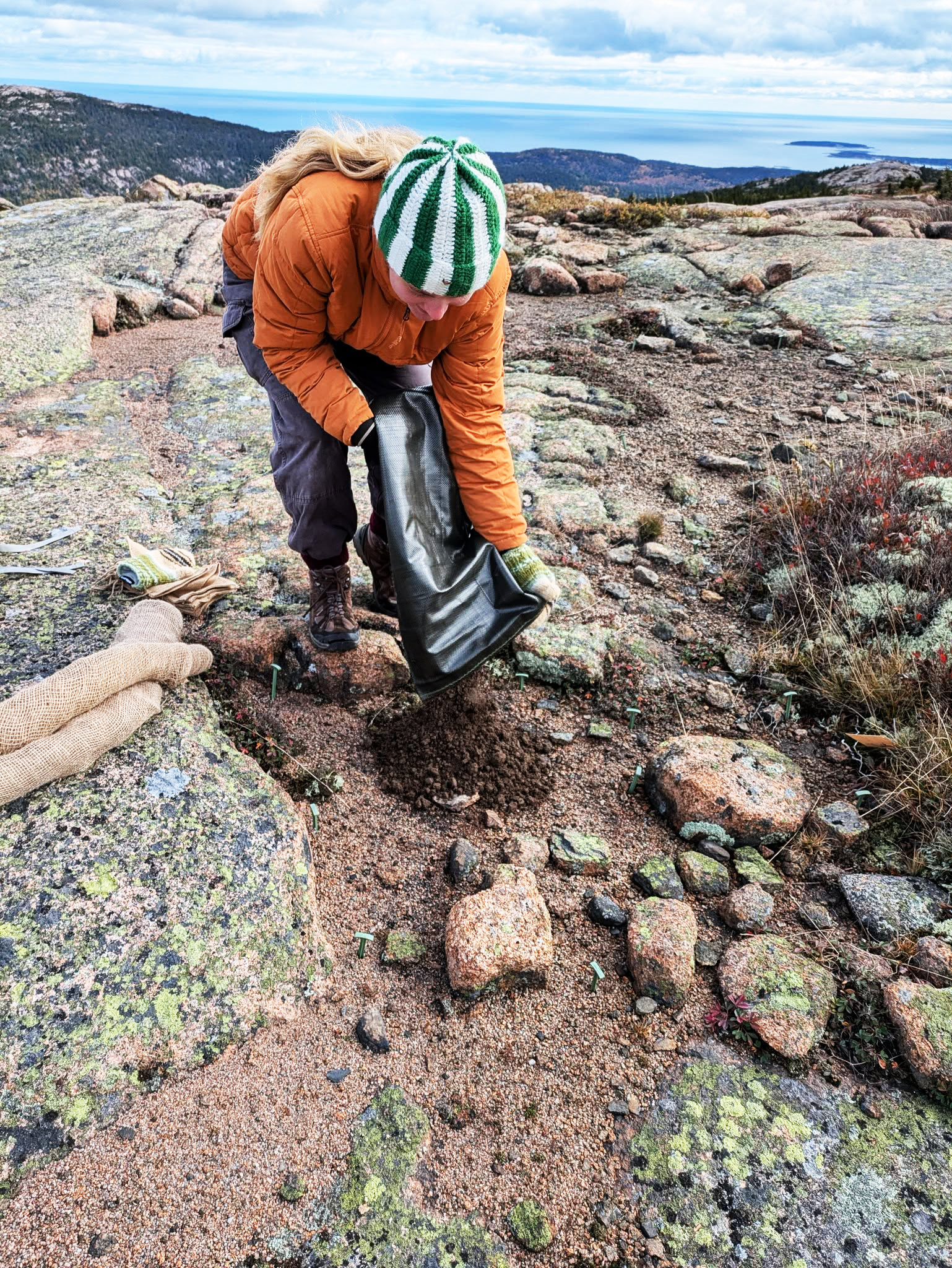
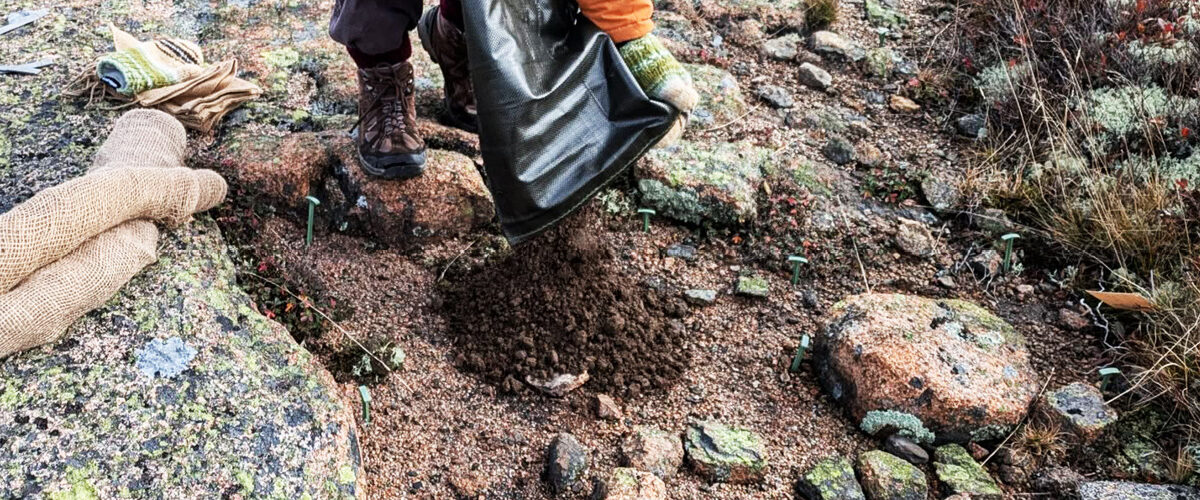
Restoration efforts will continue, with an emphasis on getting soil back up to the summits, mainly through the Save Our Summits program hosted by Friends of Acadia. Since 2023, volunteers have hiked bags of soil up Sargent and Penobscot Mountains for use in planting experiments. Neither of these mountains have road access so volunteer hikers are the only mode of transportation for the soil. In 2025, nearly 300 volunteers carried 4,560 pounds of soil to the summits.
With this soil, Schoodic Institute scientists are continuing to study which seeding methods are best for growing native plants back quickly without attracting invasive species. The next big goal is to learn more about the long term success of these restored plots in the face of warming temperatures and more frequent summer droughts.